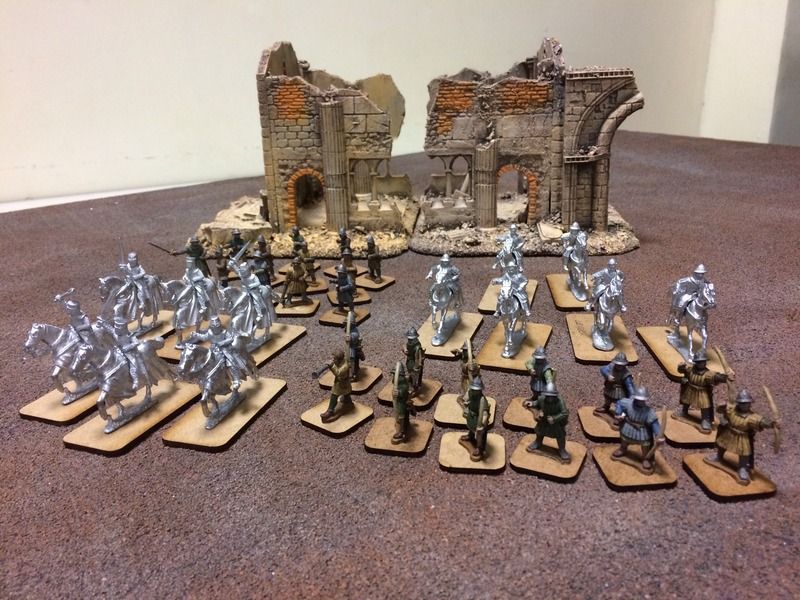
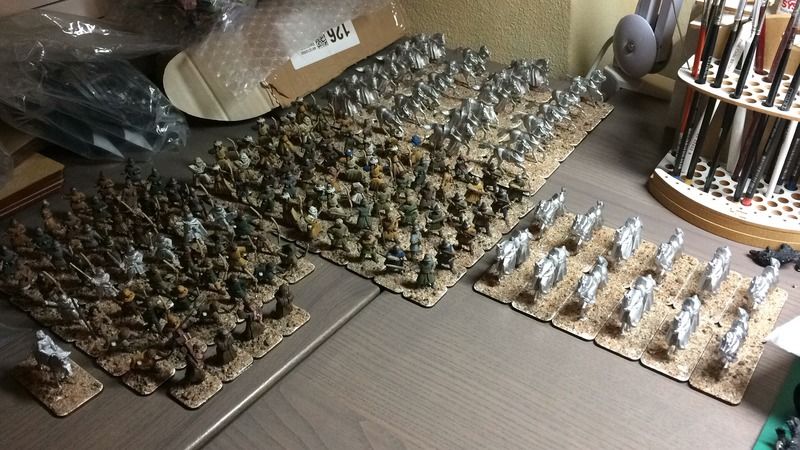
The photo of a previous blog post included miniatures of Muslim archers, whose presence on a battlefield in northern Italy probably, and rightly, defies expectations. Not to mention the fact that they were fighting for a Christian Holy Roman Emperor. When we think about a crusade that involved Muslim forces, northern Italy is certainly not the first thing that comes to mind. Indeed, there were no Muslim communities in northern Italy, and there had never been any. The Muslims fighting for Emperor Frederick II in northern Italy were certainly quite a unique oddity.
So how did Muslim soldiers find themselves fighting in Northern Italy, against Christians, but under a Christian holy roman emperor?
Well, there were no Muslim communities in northern Italy, but there were some in southern Italy. Yet in order to fully grasp that picture, we should forget our modern notion of Italy to start with. In the Middle Ages, the peninsula contained two very different kingdoms:
The ‘Kingdom of Italy/Kingdom of the Lombards’: north of Rome there was a kingdom known as ‘Kingdom of Italy’ (Regnum Italiae) or ‘Kingdom of the Lombards’ (‘Regnum Longobardorum’). It was the legacy of the kingdom created by the Lombard Germanic invaders in late antiquity and updated by the Carolingians at the end of the 8th century. Politically, this kingdom was very fragmented, divided as it was in many autonomous cities and a few lords but under the distant leadership of the emperor. Yet, culturally, this kingdom was very homogeneous indeed, since its population was Christian and its cultural language Latin.
The ‘Kingdom of Sicily’: the lands south of Rome, instead, belonged to the ‘Kingdom of Sicily’ (Regnum Siciliae), which Norman adventurers had carved up, and created anew, out of a number of different independent principalities and territories, in the 11th and 12th centuries. In contrast to the northern kingdom, this one had a powerful central royal administration, and, culturally as well as ethnically, it was very fragmented and diverse, including local Latin Western Christians, Orthodox Greeks and Muslims, plus Norman, Lombard and German “immigrants”. A sizeable portion of southern Italy had been part of the Greek world since ancient times. Then Islamic forces conquered the island of Sicily in the 9th century, and its western half soon became a predominantly Islamic country. In the twelfth century the Norman kings of Sicily, who were Latin Christians, were very culturally inclusive. They produced documents in Latin, Arabic and Greek, and depicted themselves as Muslim and Greek rulers, as you can see in the pictures below:
 |
The Norman King Roger II of Sicily (grandfather of Frederick II)
depicted as a Greek Byzantine emperor in the Church of the Martorana in Palermo. |
 |
Gold tarì of King Roger II with Arab inscription:
‘The powerful through God, King Roger the magnificent‘. |
At this point in time enters Emperor Frederick II. He was born in 1194 from Constance, a Norman Princess, and Henry VI, the German Emperor, but he was brought up in multicultural Sicily. Both his parents died when he was a child, and the succession to his thrones was very long and messy. In the ensuing wars, the Muslims of Sicily sided with Frederick’s opponents, and his final victory resulted in a violent crackdown that uprooted them from the island (Frederick had a very strong top-down approach to politics), where Latins were incentivized to settle (some Muslims however probably remained and converted). Many Muslims, on the other hand, reached a compromise with Frederick, who deported them to the Italian mainland, transforming the Apulian town of Lucera into a Muslim colony.

One might expect that that the deportation created resentment, but Frederick and his Muslim subjects actually forged a very good and very strong relationship after that. Frederick granted autonomy and protection to the Muslims of Lucera, who were allowed to keep their faith. In exchange, they became some of his most trusted subjects and allies. Generally speaking, following the tradition of his maternal ancestors, Frederick had a good relationship with the Muslim world. During his reign, Muslims can be found in his bodyguard and armies, where they especially served as archers, because of their expertise and special bows. To the Muslim of Lucera Frederick added mercenaries from Africa and the Middle East, and he used Muslim archers for garrison duties in Northern Italy in the 1230s and 1240s, in support of his local allies. There is no evidence for that regarding Lodi Vecchio, but we have very scant evidence for that battle, and the presence of Muslim archers there is certainly plausible.
In the end, however, the use of Muslims for garrison duties in northern Italy made sense from a military point of view, but, politically, it was liability. One of the reasons why Frederick used his trusted Muslims was that he did not fully trust his Lombard subjects and allies. A contemporary compared those Lombards to a slimy eel: they kept slipping from Frederick’s hands. Yet Frederick’s friendship with Muslims, and his use of Muslim soldiers so deep into Christian lands, and, moreover, against Christians, was one of the arguments that were used to criticize the emperor and to justify the launch of a crusade against him.
More on that in the next post.
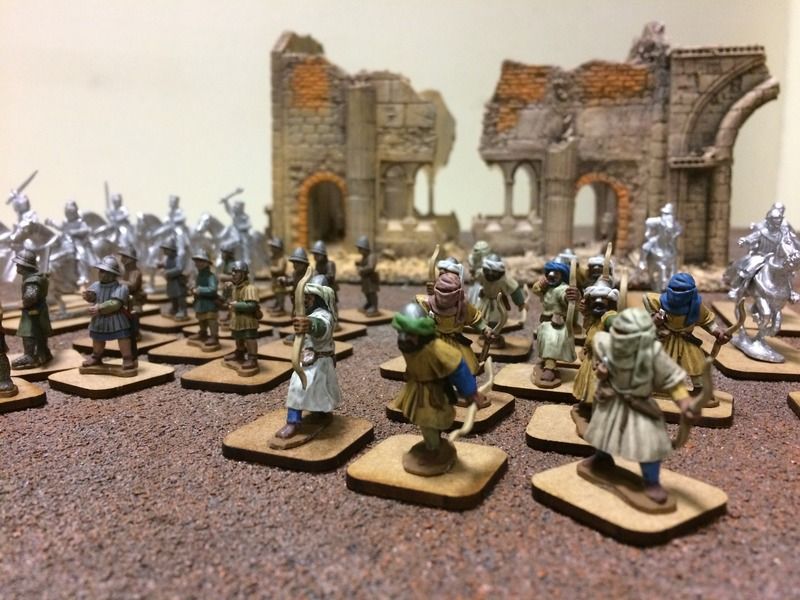 |
| Muslims in the Imperial Army for our Battle of Lodi Vecchio. |
Suggested reading:
G. Raccagni, ‘The crusade against Frederick II: a neglected piece of evidence’, Journal of Ecclesiastical History, 67 (2016), available here.
A. Metcalfe, Muslims of medieval Italy (Edinburgh University Press, 2009)