Playing with metal soldiers in the 13th century

Showing posts with label Historical background. Show all posts

Friday, 10 February 2017

Muslim soldiers fighting for a Christian ‘holy’ emperor in Northern Italy?

The photo of a previous blog post included miniatures of Muslim archers, whose presence on a battlefield in northern Italy probably, and rightly, defies expectations. Not to mention the fact that they were fighting for a Christian Holy Roman Emperor. When we think about a crusade that involved Muslim forces, northern Italy is certainly not the first thing that comes to mind. Indeed, there were no Muslim communities in northern Italy, and there had never been any. The Muslims fighting for Emperor Frederick II in northern Italy were certainly quite a unique oddity. 

So how did Muslim soldiers find themselves fighting in Northern Italy, against Christians, but under a Christian holy roman emperor? 

Well, there were no Muslim communities in northern Italy, but there were some in southern Italy. Yet in order to fully grasp that picture, we should forget our modern notion of Italy to start with. In the Middle Ages, the peninsula contained two very different kingdoms: 

The ‘Kingdom of Italy/Kingdom of the Lombards’: north of Rome there was a kingdom known as ‘Kingdom of Italy’ (Regnum Italiae) or ‘Kingdom of the Lombards’ (‘Regnum Longobardorum’). It was the legacy of the kingdom created by the Lombard Germanic invaders in late antiquity and updated by the Carolingians at the end of the 8th century. Politically, this kingdom was very fragmented, divided as it was in many autonomous cities and a few lords but under the distant leadership of the emperor. Yet, culturally, this kingdom was very homogeneous indeed, since its population was Christian and its cultural language Latin. 

The ‘Kingdom of Sicily’: the lands south of Rome, instead, belonged to the ‘Kingdom of Sicily’ (Regnum Siciliae), which Norman adventurers had carved up, and created anew, out of a number of different independent principalities and territories, in the 11th and 12th centuries. In contrast to the northern kingdom, this one had a powerful central royal administration, and, culturally as well as ethnically, it was very fragmented and diverse, including local Latin Western Christians, Orthodox Greeks and Muslims, plus Norman, Lombard and German “immigrants”. A sizeable portion of southern Italy had been part of the Greek world since ancient times. Then Islamic forces conquered the island of Sicily in the 9th century, and its western half soon became a predominantly Islamic country. In the twelfth century the Norman kings of Sicily, who were Latin Christians, were very culturally inclusive. They produced documents in Latin, Arabic and Greek, and depicted themselves as Muslim and Greek rulers, as you can see in the pictures below:

The Norman King Roger II of Sicily (grandfather of Frederick II) 
depicted as a Greek Byzantine emperor in the Church of the Martorana in Palermo.
Gold tarì of King Roger II with Arab inscription: 
‘The powerful through God, King Roger the magnificent‘.

At this point in time enters Emperor Frederick II. He was born in 1194 from Constance, a Norman Princess, and Henry VI, the German Emperor, but he was brought up in multicultural Sicily. Both his parents died when he was a child, and the succession to his thrones was very long and messy. In the ensuing wars, the Muslims of Sicily sided with Frederick’s opponents, and his final victory resulted in a violent crackdown that uprooted them from the island (Frederick had a very strong top-down approach to politics), where Latins were incentivized to settle (some Muslims however probably remained and converted). Many Muslims, on the other hand, reached a compromise with Frederick, who deported them to the Italian mainland, transforming the Apulian town of Lucera into a Muslim colony. 


One might expect that that the deportation created resentment, but Frederick and his Muslim subjects actually forged a very good and very strong relationship after that. Frederick granted autonomy and protection to the Muslims of Lucera, who were allowed to keep their faith. In exchange, they became some of his most trusted subjects and allies. Generally speaking, following the tradition of his maternal ancestors, Frederick had a good relationship with the Muslim world. During his reign, Muslims can be found in his bodyguard and armies, where they especially served as archers, because of their expertise and special bows. To the Muslim of Lucera Frederick added mercenaries from Africa and the Middle East, and he used Muslim archers for garrison duties in Northern Italy in the 1230s and 1240s, in support of his local allies. There is no evidence for that regarding Lodi Vecchio, but we have very scant evidence for that battle, and the presence of Muslim archers there is certainly plausible. 

In the end, however, the use of Muslims for garrison duties in northern Italy made sense from a military point of view, but, politically, it was liability. One of the reasons why Frederick used his trusted Muslims was that he did not fully trust his Lombard subjects and allies. A contemporary compared those Lombards to a slimy eel: they kept slipping from Frederick’s hands. Yet Frederick’s friendship with Muslims, and his use of Muslim soldiers so deep into Christian lands, and, moreover, against Christians, was one of the arguments that were used to criticize the emperor and to justify the launch of a crusade against him. 

More on that in the next post.
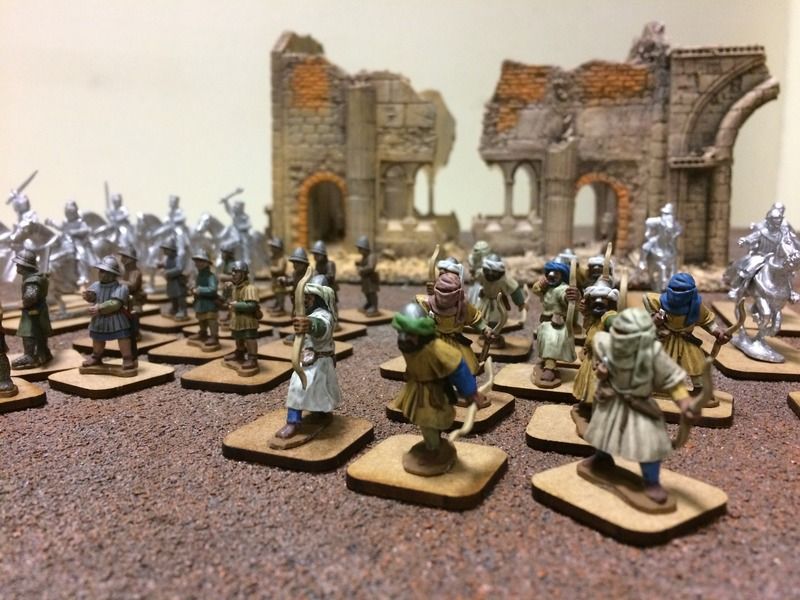
Muslims in the Imperial Army for our Battle of Lodi Vecchio.
Suggested reading:

G. Raccagni, ‘The crusade against Frederick II: a neglected piece of evidence’, Journal of Ecclesiastical History, 67 (2016), available here. 

A. Metcalfe, Muslims of medieval Italy (Edinburgh University Press, 2009)

Sunday, 8 January 2017

The Battle of Lodi Vecchio of 1239

Here we are with the second installment of our blog. First of all, let me thank those who had a peek at the first one and found the time to read it. 

Today we analyse the battle we are trying to reconstruct, which took place among the ruins of the old city of Lodi in the spring of 1239 between the armies of Milan and Lodi. Not very much is known about the fight itself, the number of forces involved and the name of the commanders besides the papal legate, Gregorio da Montelongo. All our informations come from this excerpt of the Annales Placentini Gibellini, which were written a few decades later:

1239. Indicione 12. De mense Aprilis domnus papa direxit Gregorium de Montelongo eius notarium et legatum in civitatem Mediolani; qui statim ut ibi accessit, sumptis civibus de mandato eius signo crucis et paratis duobus vexillis cum crucibus et clavibus intus, venit ad Laudum vegium, et ibi cum Mediolanensibus sua tentoria finxit destruendo turres ecclesiarum et segetes devastando. 
Annales Placentini Gibellini, ed. G. H. Pertz, in Monumenta Germaniae Historica Scriptores in folio, vol. XVIII, Hannover 1863, p. 481. You can find the text online here.
In 1239 the Lodigiani were allies of Emperor Frederick II, and they had regained control of the site of Lodi Vecchio. As soon as Cardinal Montelongo reached Milan on a papal mission, he authorised the Milanese to take the cross (which is a quite unmistakable reference to a crusade), and having prepared banners with the symbols of the cross and of St. Peter’s Keys (which was the coat of arms of the popes), they successfully attacked Lodi Vecchio, destroying the towers of the churches and laying waste to the surrounding fields. Then, Montelongo pitched his camp in proximity of the city, almost surely an act of open defiance against Lodi and the emperor. The actions of the Milanese on that occasion do not look particularly pious and crusade-like. Yet we need to remember that the author of the Annales Placentini Gibellini generally showed sympathy for the imperial cause and its supporters, and we should take his writings with a pinch of salt.

We chose it because it is the first recorded example of a military clash in northern Italy that shows crusading features. Actually, it is a very intriguing case, because it preceded by a few months the official launch of the crusade by Pope Gregory IX against Emperor Frederick II, which took place in 1240. The adoption of crusading features at Lodi Vecchio might have been a personal initiative of the provocative Cardinal Gregorio da Montelongo, whom the pope had sent to Milan to foster local resistance against the emperor. In other words, the battle of Lodi Vecchio was probably a test, whose success contributed in convincing Pope Gregory IX to take the momentous step of launching what was the first ever crusade against a Holy Roman Emperor (which might look like a contradiction in terms), thus introducing internal crusades to northern Italy.


On the other hand, it could be argued that the crusading features of the battle of Lodi Vecchio added a religious coating to the traditional enmity between the cities of Milan and Lodi. Milan was the most important city in northern Italy, and the main foe of the emperors there. Milan wished to bully and control its smaller neighbours, like Lodi, which, in turn, sought imperial protection (the rebel alliance in northern Italy was not that good after all). Indeed, by 1239 the two cities had been fighting intermittently for more than a century. Lodi Vecchio was the original site of the city of Lodi (an ancient Roman settlement itself), which the Milanese had destroyed in 1158, leaving behind only ruins and a few standing churches. The expelled inhabitants of Lodi (called Lodigiani) rebuilt their city (‘New Lodi’), with the help of Emperor Frederick I Barbarossa (the grandfather of Frederick II) a few miles away, in a more defensible position. Since then, however, Lodi had been trying to regain its ancestral homeland and the Milanesi had been trying to prevent it. The situation recalls the fate of Osgiliath, the famous ruined battleground of the Lords of the Rings.   

We will examine the controversial figure of Montelongo in one of our next posts, but here's a teaser of the model from Gripping Beast we have chosen to represent him on the battlefield. You can find it in their online webstore:


If you want to read more about the crusade against Frederick II and the Italian city republics, Gianluca's article on the subject is free to download at this link.

Soon we'll talk about Lion Rampant!

Friday, 6 January 2017

The beginning


So, this is where everything starts...


My friend Gianluca is a lecturer in medieval history at Edinburgh University and last summer revealed me that there was a chance to obtain funds to promote the diffusion of academical subjects to a wider audience, breaking the boundaries of formal education.

We had no hesitation: historical wargames!

We decided to apply and - boom! - our project was accepted!

Rebels to the Empire and Crusades Against Fellow Christians in the Italian City Republics

An overlooked but very significant part of the history of the crusades relates to those that were fought against fellow Christians. They are known as internal crusades, and were launched against heretics, their supporters, and opponents of the Papacy within Western Europe. Internal crusades started from the beginning of the thirteenth century, more than a century after the first crusade against Muslims. Scholars distinguish between internal crusades fought against heretics and those against political opponents of the Papacy. Yet they both had political features, and opponents of the Papacy were branded as heretics anyway.

Exploring internal crusade helps to test the current dominant emphasis on crusades against Muslims, suggesting a more balanced view of the crusades and of their impact on Europe.  Considering those that were fought in northern Italy also helps to explore the evolution of such a unique phenomenon as the medieval Italian city republics from a new and different angle.

Of all the battlegrounds of the internal crusades, the city republics of northern Italy hold a special place because they were quite unique experiences of non-monarchical government and popular sovereignty, while the rest of Europe was rather dominated by kings and lords. There were around thirty main cities, which were virtually independent but recognised the weak overlordship of the Holy Roman Emperor (who was usually a German). The emperor claimed to be the highest temporal authority in Europe, but by the thirteenth century he especially exerted different degrees of authority on a strip of territories that went from northern Germany to Sicily. The Italian cities mainly battled each other, or faced internal factional strife. Yet they seldom also dealt with emperors who wished to enhance their authority over Italy. On those occasions cities coalesced in pro-imperial and anti-imperial leagues, and the latter usually struck an alliance with the pope. The emperor and his Italian supporters labelled their opponents as rebels to the empire (rebelles imperii - just like in Star Wars).

In bold the city states and in italics the major lordships of Northern Italy in the 13th century.


The first full crusade against fellow Christians was launched against the Cathar heretics of Southern France in 1208. The Italian cities were also accused of being hotbeds of heresy. Yet it took more than three decades for internal crusades to be introduced there, starting around 1240. The reasons for that delay are not clear, but, initially, internal crusades were probably quite controversial. Moreover, northern Italy was key in the troubled relations between popes and emperors, because, geographically, it was the link between Germany and Rome. That meant that popes needed to tread carefully with the Italian cities. Indeed, it is not by chance that the first crusade against northern Italian targets belonged to the first crusade that was launched against a Holy Roman Emperor around 1240.

That's it for the background of our endeavour. I'll soon delve into the miniatures' side of the subject and our reconstruction of the Battle of Lodi Vecchio of 1239.